Thursday, September 20, 2012

Sweet Sweat Runs

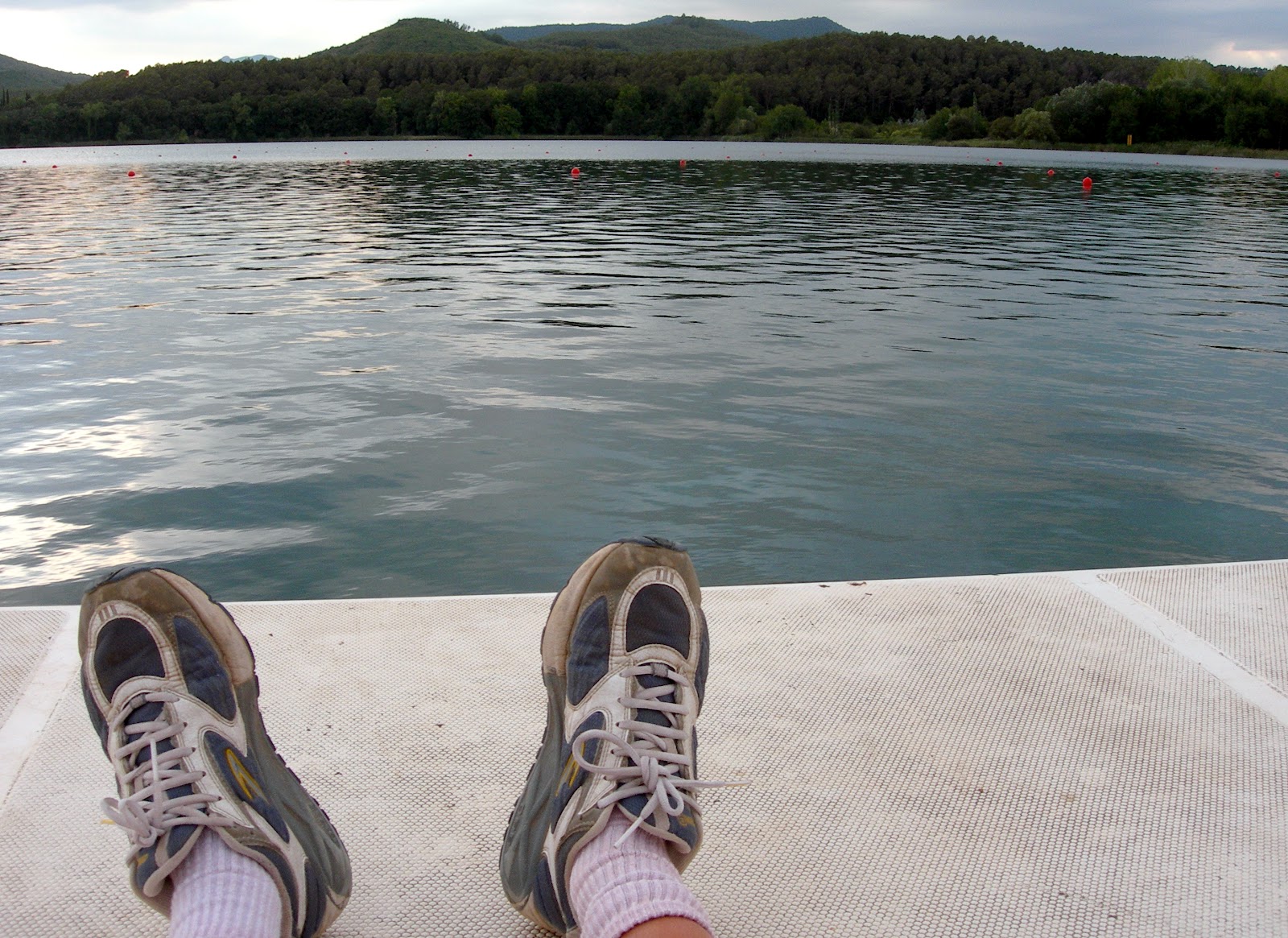
On the docks in Banyoles, Spain
Piediluco
Sweat runs are often a mixture of love/hate. Tired legs from depleted body carries you out the door to lose weight, to make weight or maintain weight. Unlike the performance factor you push up against in your rowing race, this part of your training is something between stretching and heart rate sustenance. You don't want to work too hard, tiring you out for your real race, but you don't want to walk either. The job needs to get done as quick as possible. To sweat. And if you can get distracted by the surroundings, all the better, with sweet memories to follow. Here are some of mine gathered from my rowing racing sweet runs.

Banyoles, Spain
In 2009 for the Memorial Paolo d'Aloja, I remember running through the streets of Italy in Piediluco. My first experience of running to make weight. The other lightweights thought this was a drag. But I thought this was the coolest experience ever. The setting sun made all things European flicker in their difference to what was familiar. Cobbled roads, old ruins from ancient times, Italian voices. A snapshot of a European way of life that I physically, was being a part of and moving through with all the senses. I never felt so alive.

My second rowing-running memories are gathered in Spain, Banyoles where running becomes more than just weight-making. Its my pre-race focus in a warm-up and my after race recovery cool-down. Its just that ‘me’ time where I align all my anxieties, get ready to show my stuff on the water. Rowing is very technical and having the ease of the run sets me up to have all my nerves ready to perform.
Running in Galicia, Spain

Somewhere in the northern part of Spain, we went to a race.  It was possibly in Galacia, but I can't remember the exact location. I just remember running around the lake area to see little delicate vines, around huge power lines that overlooked a grand lake on which the rowing races were happening. I also saw the European villa houses that were movie tuscany-dreamy quality. The  orange trees added more beauty to the scene. It was nice!
River Trail in New Zealand

Hunt Drive - Fulmer's loop
Running for the 2010 World Champs in New Zealand was quite a fair. It was in November (Spring-Summer for the Southern hemisphere) and it was not as warm as I would have liked. Sweating took some work and more run-exploring. We stayed at the Kingsgate Hotel in Hamilton but the rowing happened in Cambridge, Karapiro. My explorations at pace soon found me at Minogue Park, near our Hotel. Like a child the large open fields and hills made me giddy as I covered the distance. When on top of the hill (koppie) I would have a stare out moment over my world. One day Netball games were being played close by. That was a great blast from the past. Haven't seen or played Netball since 2002, and it was such a big part of my life for 12 years. Just off Minogue Park, there was a horse track. Running laps around this track also gave me motivation to keep going on my sweat run. Perhaps remembering track training days with Mrs Erasmus at Willowridge, or perhaps thinking of the sheer strength, power and grace that the thoroughbreds exurb as they are jocked around the track. Those galloping strides paced me. From Kingsgate I was also recommend to head east towards the River Trail. This was a runner's haven. Long, unending trail roads, free of cars, winding along the river. Green luscious ferns pathed your way. Sometimes I thought I was on-set for a dinosaur scene. Once I also ran along the main street to just see the businesses and shops. Along the way there was a huge pile of tracker tyres. It was meant to be climbed and I couldn't resist. Like a obstacle course, jungle gym, I went up and over the tyre mount. A little embarrassed, I carried on running.
Wooded trails run
from my Garmin Connect
Another simple place to run is in the neighborhood of the Fulmer's. I run loops in the circular cul-de-sac. I turned my focus to my pace instead of frustration of limited space and making circles. I let my pace set in a deep rhythm needed to win my race. Further down the road is a great park I exploring the trials. Somehow it all connects Although once I ended up really far out. Thank goodness I had my iphone maps to direct me back.

Now running in Seattle, around Lake Union is also a staple run. Along the path of house boats, to wood panel boardwalk of South Lake Union. Running up the stairs to get over the Freemont bridge, and dropping back down into the Burke Gillman trial. Inside gasworks parks, running up the hill, close the water wall and back out. Along the trail, passing the rowing clubs of Lake Washington, Pocock until I get to my club, Lake Union crew.
Lake Union Run 
Lake Union View over towers of Queen Anne
View when running over Freemont Bridge


Another staple run takes place in Amsterdam. Running around the Aalsmeer lake is my ultimate distance run. Just under half a marathon, the run takes you in and out of the water's view. At times you feel like it just won't end, but then you see the water tower (which looks like it was built for the set of Transformers) and like a lighthouse, it brings you home. Thank you Otimus Prime for some stamina! Also in Amsterdam are my Bosbaan runs. This is the course where we row as well, so great to run the 2km out, there and back, and then also to wonder into the forests that surround the bosbaan. At first getting lost in the wooden trails was very overwhelming. Now I have it down, and found many little hidden gems in the wood. Like pools, big hockey fields, restaurants, and forest theaters. But the biggest surprise was finding the obstacle course. This is just like something we would do at veldschool (bush school) with ropes, tyres and legs to walk along, get over and conquer!
Bosbaan - Amsterdam
Around Aalsmeer Lake
More runs in the Netherlands also include the City of Delft along the River Schie and in Rotterdam along the River Rotte. Delft is a small quaint little city. Running through the square is also charming, finding little bridges crossing the ever winding waters ways. Or you could run out into the polders and the bike trails and just really run or bike for hours. Seeing bikes broken, warped and locked are common all over Delft, Rotterdam and Amsterdam.

Kandelaar Bridge in Delft
500m board on Lake Lucerne
Running around the city of Lucerne, Switzerland at the World Cup planted some great memories. I remember the cow bells clanging on the hills as I ran along the course. I would hear them when we rowed too. The Rotzee is beautiful. The jewel for all rowers! I also enjoyed running out to the bigger Lake Lucerne with views of Mount Pilatus. The out and back run to the 500 mile mark cafe would get me through. To see that 500m sign and look over the water and setting sun was magical. As I run back and get back into the little city, seeing Helvetica-typeface signs constructed on top of the buildings also delighted this designer's viewpoint. Helvetica developed in 1957 by Max Miedinger and Eduard Hoffmann aimed to have neural properties that exhibited great clarity. Perfect proportions in spacing and lines, just like the Swiss-German culture. 'Helvetica' means 'Swiss' in latin.


Track in Bled
In Slovenia, we competed at Lake Bled. So I ran around Lake Bled. A beautiful foot path that also have horse and carriage coming by. People strolling with big ice-creams was also a common site. Its a nice loop. I also started exploring the outskirts of the city and came across a beautiful athletes track. This excited me to no end. I made my loops around the track, and even did some harder 400m's work. Man, I remember those 400 days with coach Garry and Mrs Erasmus clocking every one. The rest in between just a painful pause to when you need to line up again!

Running around Lake Bled, Slovenia


Lake Samish, Bellingham
Back in the USA, I have also spend hours pounding the pavement around Lake Samish in beautiful Bellingham: a town north of Seattle, just a stone throw from the Canadian border. Also a lake loop letting you see the waters you are row from a different perspective. One side of the run is not as pleasent as it borders the highway (I-5). That was motivation to run faster so it could be over quicker. There was also another small lake called Lake Padden that was super fun to run around. This was all trails and Abby and I would run this more competitively though, for real training, while others bbq's and swam.

Lake Stevens
I used to live in Lake Stevens, and so wasn't long before I found myself making the lake loop. I rode it first on my bike figuring out the path. Then later we got a little furry companion, and he was soon trained to make the run. Remus is a american pit. Unlike his breed his known for, he is slender and swims like a fish. We start the lake loop in different strides. First he will be pulling me, and then after 50min, I pulling him to make the last 20min. Good team work I would say. Miss my little guy! Best running partner I ever had.
Remus, best running partner

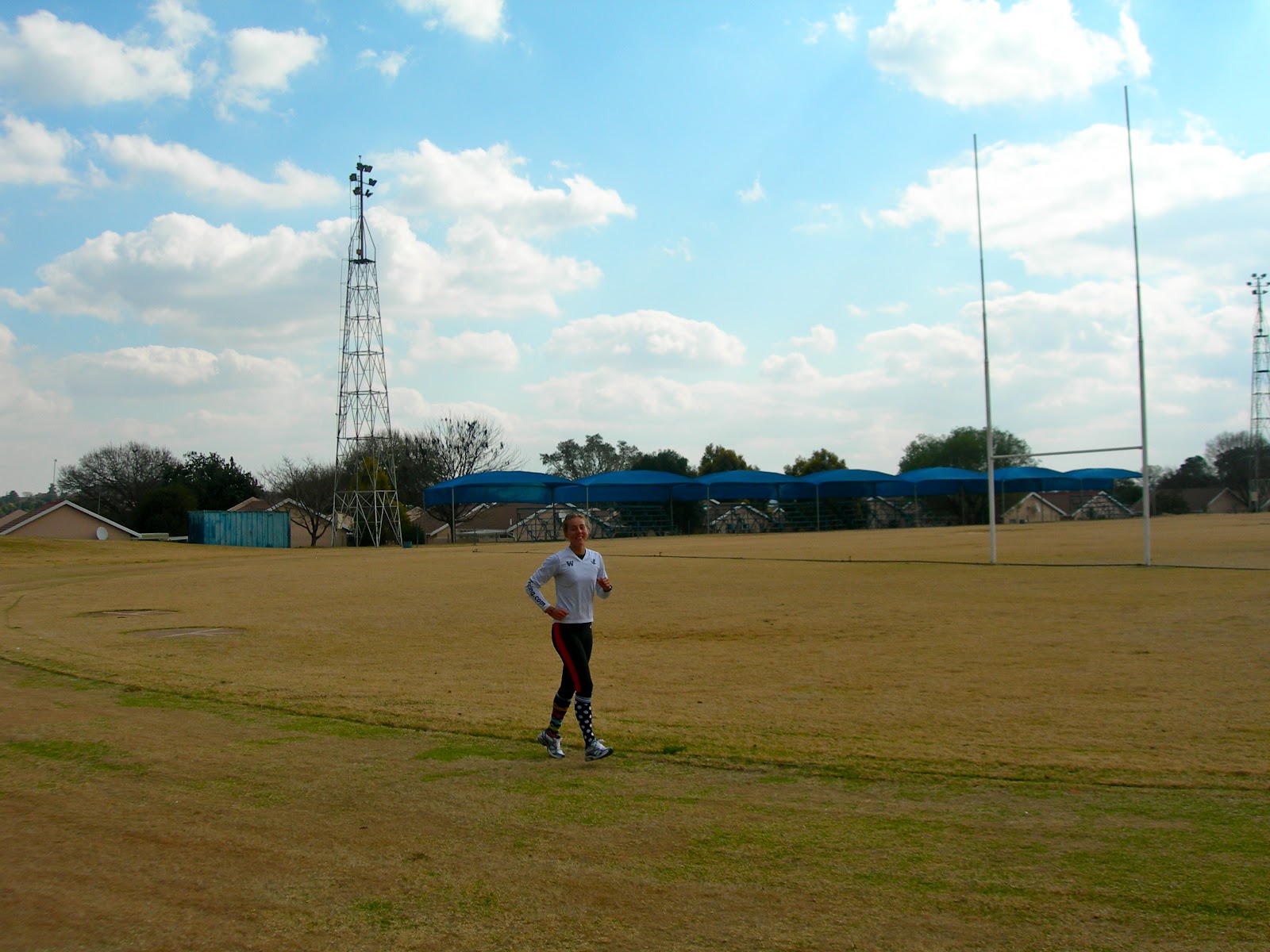
From one side of the globe to another, running in South Africa, even now after my junior days is till a blast. There is a nature reserve close to where I live called Groenkloof, with hiking trails that I ran through. This sounds unreal, but as I ran, there were Zebra's and Giraff and Rhino. Only in Africa!
Groenkloof nature reserve

Willowridge High School Track


Thank you to Super Jock 'n Jill in Greenlake who fitted me in Brooks and I have never looked up. I love my Brooks, that support my pronating running style and have reduced my shin split injury to zero! Super Jock 'n Jill supplied me with sponsored shoes for my olympic endeavor. Please support these guys and they have me. I would recommend this store over and over if you are looking to buy good running shoes!

More::


Sunday, September 9, 2012

Moving the Start

When I was running around the Willem-Alexander Baan, and I saw Martijn standing on the starting platform while it was being moved from the 1000m mark back to the start of the 2000m, I had to capture this camotion. Now when you tell me the start has been moved, I might think twice about the time or the actual whole starting platform.

Friday, September 7, 2012

Understanding boat selection in USRowing

I have been asked many times how the USRowing boats are selected, mainly because the process seems unfair. So to date, subject to change, this is how it goes:

In USRowing there are two systems that are the same for the men and women's team:
1. Camp Selection
2. Trial Selection

-with some overlap of training support and centers in between.

The distinction of Olympic and Non-Olympic events are also treated differently.

All small boats are trial selection: 1x, 2x, 2- (lightweight & openweight).
Big boats are camp selection: 4x, 8-, M4- and LM4-. But the lightweight quads and women's four fall into trial selection because they are Non-Olympic events.
Thus funded, Olympic, trial events racing at NSR are: W1x, M1x, W2x, M2x, LW2x, LM2x, W2-, M2-.
Unfunded, non-Olympic, trial events racing at Senior Trials are: LW1x, LM1x, LM2-, W4-, LW4x, LM4x, LM8-.
Funded Olympic camp events named by the coaches are: W4x, M4x, M4-, LM4-, W8-, M8-.

Camp selection means the national team coach is picking all the seats. Athletes are required to train together at a USRowing supported venue, such as Princeton, San Diego or Oklahoma City and most expenses like coaching, training venue, equipment and training center gear is covered. There is also an athlete income for most of the rowers in in the camp selection.

In trial selection, athletes are free to pick partners, coaches and a training place. However they, personally or through their club will need to cover all costs for this. In trial selection to be on the national team you need to win the final at NSR or senior trials. It's a great cowboy-maverick approach where you row, train, race all on your own, wherever you want, and with who ever you want, coached by who ever you chose. If your event is Olympic, then your hotel, flights, coach and equipment will be paid for when you go race the World Cups and World Championships after winning the NSR. You also start to earn a little monthly income that is helpful with health care benefits. However, if your event is Non-Olympic, then after you are named to the national team from winning the senior trials you need to pay for everything when you go race at World Cups or World Champs (hotel, flight, boats, coach, equipment rental, transport). And there is no income or health insurance. So when I'm raising funds for my lightweight single I sometimes feel like a starving beggar, palms open, happy with any scraps spared.

USRowing has limited liability as they are a non-profit, organizing federation. Thus their endeavors of goodwill are scrutinized to buffoonery because they have to compete as a governing body against professional federations with government funding. And whilst rowing is revered for its amateur status in the United States (going for the dream with no financial gains) it doesn't make a culture of winning sustainable. Its a random diamond in the rough moment with great stories.

Further the USA is the only country that is governed by a law called the Ted Stevens Olympic and Amateur Sports Act. It says that athletes cannot be denied opportunity. At our national team trials there is no selection procedure based on results. Absolutely anyone can enter and race.
"No member of the corporation may deny or threaten to deny any amateur athlete the opportunity to participate in 
    • the Olympic Games, 
    • the Pan American Games, 
    • the Paralympic Games, 
    • a World Championship competition, or 
    • other such protected competition as defined in Section 1.3 of these Bylaws..."
Further or firstly, this Act also grants legal monopoly status to the USOC, a non-profit corporation, which is in turn empowered to recognize other corporations (e.g., USRowing) as "National Governing Bodies" (NGBs) for their respective sports. All stay non-profits. In 1998 the Act was modified to include arbitration requirements imposed on NGBs for conflict resolution in athlete grievances.

A wonderful concept in principle, just like a non-profit rowing federation. But in reality these things make achieving medals in rowing that little bit harder. Teams and selections in the USA are done at the very last moments. With no platform for development the trial boat athletes will rather continue in their self-selected boats with their partners and setup, because they have invested so much outside resources into in. In other words, if your 2x is not meeting up to the speed checks in racing, athletes rather just stick it out because the options to go back to a base with other athletes to retest is not in place. If this way of thinking was in place, it might mean that the athlete might not end up on the team. So there is pressure to decide between making the team or doing what ever makes the boat faster, even at your expense.

Coaches too get the chance to go to world cups as paid USRowing coaches if they are named by the athletes in Olympic trial boats. Athletes have the capacity to name family or friends as their ‘coach’ to join them at international rowing venues, paid for by USRowing. If your event is non-Olympic, athletes must factor in their fundraising monies, paying for the coach as well as themselves.

So fair or not, this is the process. It has a short term focus. Athletes are required to pick their boat and race in that selected event only. Athletes in small boats trials are not in a squad and the possibility of changing boats or partners is not possible. This process runs on eligibility instead of selection. It is more about filling the team than making selection decisions based on competition results. In business, if after 3 years you don't show profit, your business is termed a hobby. Could this be applied to 3 years, or 3 races without a result, does that then start looking like a hobby?

Friday, August 31, 2012

Cyrillic and Cats - General landscape stories of Bulgaria


Bulgaria, (Plovdiv) was very curious. Its the second largest city in Bulgaria with Sofia being the first. Plovdiv dates back to 4000BC ranking it among the world's oldest cities. The city was first called Philippopolis. In the 14th century it feel under Ottoman rule until liberated by Russian armies in January 1878. Only later in 1885 did Plovdiv become part of Bulgaria.

Happy Bar and Grill with its Sushi bar
I'll start with my experiences of Bulgaria with my foodie interests first: The food was great! Close to where we stayed there was a place called Happy Bar and Grill. Now the name turned me away right away, but after I tried their spread, I was thankful for this place. Having to make weight and concerns of fresh food and water not being clean, Happy came through for us. No-one got sick! Beautiful salads and meat-only dishes, and the watermelon plate was a real hit in the heat and after race recovery! The menu had great options, nothing greasy. There was even a separate sushi chef that accompanied the menu option. An english menu helped, because unlike other places in Europe where you can kinda make out what it is, in Bulgarian we don't even share the same alphabet, so there was no understanding the text. The bills looked like the rosetta stone. We just had to trust but luckily Happy was so cheap after you convert the Bulgarian Lev to Dollar. Almost half. This helped the budget a lot! "So lets go get Happy!"

The grocery stores were laid out in a interesting pathway. Once you enter, you walk through the isles almost in a set way, that leads you finally to the checkout. But trying to get back to the first isle there is no connecting 'lanes'. You need to literally retrace your path.
The stock was simple. Nothing too cultural, except these two things: 1. Supplements and eggs. Now I guess Weightlifting is without doubt their most successful discipline. So even in a modest selection of food, shelfs don't lack space for an array of protein powders and supplements.  

Then the eggs could be bought in a little plastic packet that looked hand tied. It also looked like a farmer collected his eggs and put them in this modest packet and brought it to the grocery store. It looked like something from a farmer's market. I loved seeing that in the supermarket. It was the two worlds combining. The produce too looked so farm market like. Just displayed in blue crates, still with dirt and leaves in. As if the produce was picked from the farms and brought in to the supermarket. Nothing shinny. For sure there was no wax on these apples. And not packed out in perfect pyramids. It just looked so real. In the aeroplane magazine, there was an article on organics in Bulgaria, and a store called Balev Bio "Mapket". I guess the 'p' is an 'r' to us. Walking in this store, it had all the looks of a health store. But I questioned the organic term, because the blue crates in the local supermarket seemed more organic than this. The Balev Bio mapket stocked things that looked forcefully healthy and at high premiums. If pasta is processed, imagine how much more handling in gluten free pasta with a longer ingredient (preservative) list added to make it bind. So just to avoid gluten, you get a lot of extra crap that I don't think are worth it. So then the boxes better bling with lots of design to make you pay more to give you the comfort of value for money.
Cats are pests there. Like crows they wait for anything. We had a glassy-eyed friend who found us constantly. And by the trash cans they wait. Sometimes young children too.

Just as I said nothing shinny in the stores, there was nothing shinny about the people, the cars or buildings. They had nice cars but they were covered in dust. Their seemed to be no pretense here. The inside was more important than the outside. Things kept very simple. 

 The city is broken down. Ancient ruins are among abandoned buildings. Both old and new now crumbling to dust together. The streets are cobble and cracked. Lots of smoking people. As I went for my runs, I crossed open squares with nice bistro tables, casinos, central park- but broken windows never far from view. We walked up to the old city to where the theatre was. There the opening ceremony was to be held. It was nice to see the historic buildings, churches and museums. But most interesting was a comment from a street seller. He couldn't believe we were American. Too skinny he said. One half of the world dying from no food, other half dying from too much food. He also ventured into political views saying when Bulgaria was communist American would come. Now no tourists from the USA are passing by. He had no idea about the rowing event happening.
The entrence to the apartment

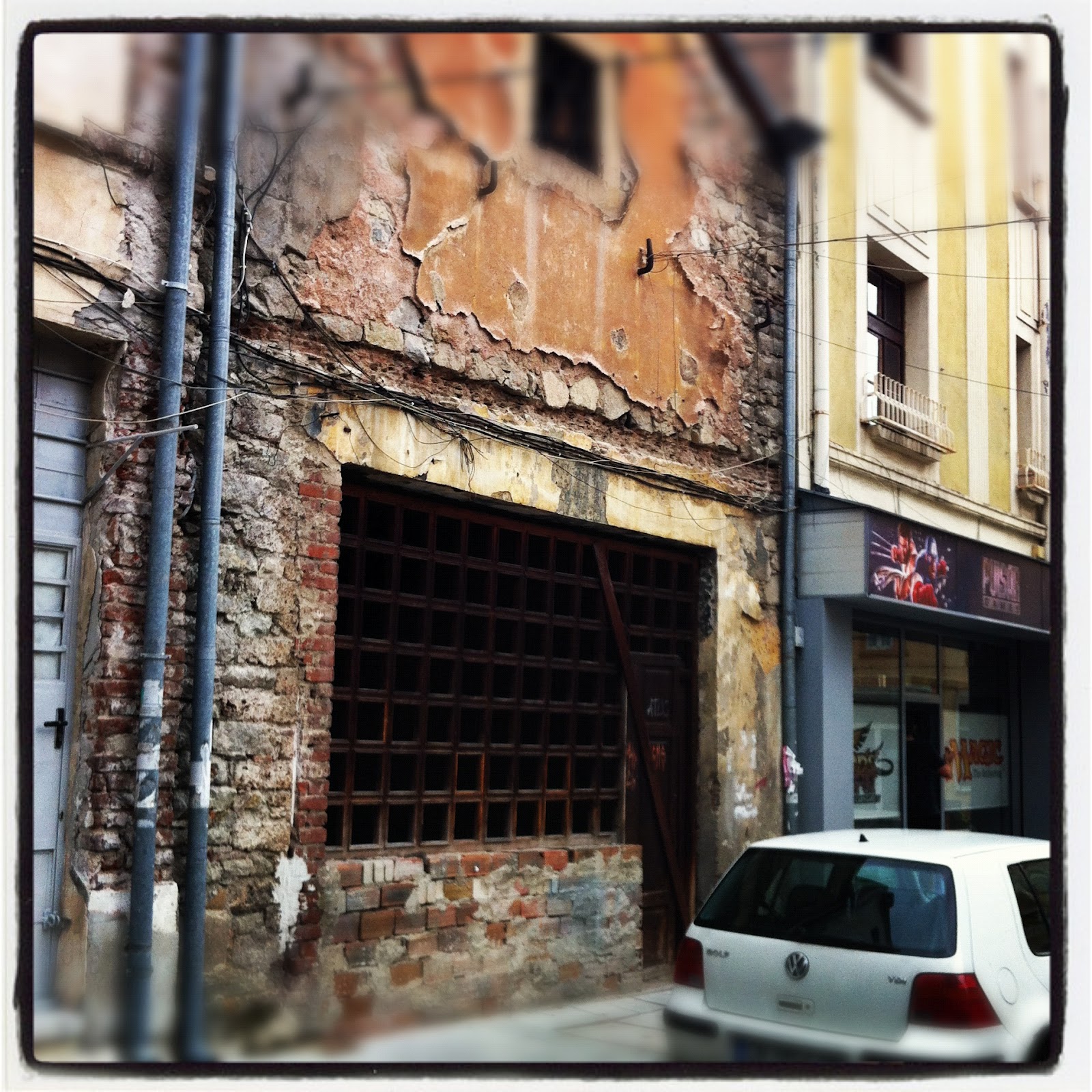
We stayed in an apartment called Luxury Studio Plovdiv. The entrance way was scary. A door next to a barred door looking like it was the entrance to an undercover dance club or bootlegged bar. Then we had to climb 6 flights to the apartment. Our routine was: down stairs (going down always seemed to pass so quickly). To the bikes which we locked to the stairwell. Unmangeling all the chains and bike locks. Bike to the course over the river. Row. Bike to Happy. Lunch. Back to apartment, lock bikes and climb stairs. This time every floor was counted. Every sticker on the door known for its sequence of how many more steps. Into the air-con room.
The rowing course and venue was really nice. In three days they suddenly erected big change rooms with nice shower facilities. The course is decided by an overhanging pedestrian bridge at the 1000m. The first time I passed under instinct caught me ducking. There are wide lanes on both sides of the course to run and bike on. Great for coaching. 

The weather was really perfect for racing. It was very hot in the first week we were there, but the second week, including racing was great. I saw my favorite German weigh-in ladies again! Thank you.

The race was not as I wanted in terms of results. But it was a solid performance. Unlike last year's world championships where I hit the buoys, and was devastated afterwards, this race I was excited to get back on the water to improve. Marie-Anne asked me afterwards how do I feel that the racing is over. She said she felt relieved as the weight has been lifted off her shoulders. I felt as if I've come home and my house was robbed. Two wooden medals are enough for me.


Roman Theatre
Country Bulgaria
ProvincePlovdiv
MunicipalitiesPlovdiv-city
Established4000 BC
Government
 • MayorIvan Totev (GERB)
Area
 • Total101.98 km2 (39.37 sq mi)
Elevation164 m (538 ft)
Population (2011 census[1])
 • Density3,316/km2 (8,590/sq mi)
 • City338,153
 • Municipal body403,153
Time zoneEET (UTC+2)
 • Summer (DST)EEST (UTC+3)
Postal code4000
Area code(s)(+359) 032
Websitewww.plovdiv.bg

Bio Food sites:


Monday, August 20, 2012

Final Round up of Bulgaria

Photo from USRowing
We arrived at Sophia airport in Bulgaria about 10 days before racing. This is common for countries outside of Europe, to arrive much earlier, for the adjustment to the eight-plus hours times difference. In fact New Zealand was already there. A very hot Plovdiv, Bulgaria welcomed us. The heat would continue for a few days. Then just as racing commenced temps cooled down to perfect racing conditions.


The first race started on 15 August with four heats. We had the most entries for the Lightweight women's single ever! Only one entry away from going to quarters and that would make history. This is a non-olympic event and this is why it is not usually that well supported. This event is used as a stepping stone to prove speed for the Lightweight Double that is your olympic event. And further more, for USA athletes, if you are in the LW double, you are funded. But because of the Olympics, many girls who didn't make that elusive double came to end their season by racing the single, or even as a special mention, girls who came from the Olympics raced again in the Lightweight single. So it was a packed field.


The heats were meant to be at 6:40pm. I was making provision for rowing so late, since that was an usual time. But the night before, the draw came out and racing time was now 4:30pm. The progression from the heats was tight. Only the winner to semi, the rest to reps (also known as last chance racing to stay in the game). Now I'm not particularly well versed in reps. But when I saw my line up in the heats, I guess I knew I was thrown in the deep end and it was time to sprint. There would be no easing into it.  In Heat 1, you had ALG's Amina Rouba who I meant at the Holland Beker, BRA's Fabiana Beltrame who won the 2011 World Champs, DEN Rikke Quist who's brother performed an amazing win in the LM2x, and GBR's Kat Twyman who comes from the British Lightweight doubles matrix camps.

Heat 2 had AUT's Michaela Taupe-Traer who had been winning two the the World Cups this year, NZL's Lucy Strack who was in the New Zealand double that raced me and Abby out of the LW2x final in the 2010 World Champs, and FRA's Elise Maurin, who I also met in a few races.

Photo from World Rowing
Heat 3 I was in, but so was AUS's Alice McNamara, GRE's Alexandra Tsiavou who was coming from a bronze medal in the Olympics, BLR's Alena Kryvasheyenka who won the U23 LW1x and IRL's Claire Lambe who raced in Brandenburg.
Rowing with SA junior guy
John and the NED coaches

Heat 4 had my training partner from NED, Marie-Anne Franken, and SUI's Pamela Weisshaupt who came 3rd in last years World Champs and also won World cup 3 this year.

So the country countdown begins, Attention.... waiting for the red light to turn green, confirmed by the sound of that distinct buzzer, and we are off. Down the buoyed lane course, setting postion, fighting that first 250m. I was excited to get a feel for the speed. I had an outside lane, so had the advantage of racing on my own focus, but also had to check in to see where my position was. Yip, Greece was gone. I knew going into the last 250m she would win this heat, but it started becoming a tight finish for me and Alena from Belarus. She took the second on me to come in second. It would be DEN, AUT, GRE and CHN to go straight to semi's and the rest of us met the next day for the reps.

Four reps, starting at 4pm. I was in rep two, with NZL and NED and GBR. This time top two to semi. Every race was really a tight fight to make it through to the next round. Usually you can have some confidence in the first steps, or even the rep. But here, before me was another hard race. Off the line we went, and I was working my rhythm. Stroke for stroke, going through my learned processes. At the 1500m mark, I started to confirm positions. I saw that Lucy from NZL was in the lead. But on my right I was fighting with Marie-Anne. We were both fighting for this semi-final spot with all we had. We trained together. Our coaches knew each other. We knew each other's strengths and we also knew the weaknesses. "Go Ursula Go", I chanted. The red buoys of the last 250m came in sight. I heard the finishing buzzer, and I looked over. I had crossed in second. We had the fastest rep time by more than five seconds. Also going through to the semi finals were ITA, AUS, BLR, SUI, BRA and IRL.
Nienke getting ready for Marie-Anne's race
In less than 12 hours recovery, I was lined up again, in lane 2, making my way to the top middle lane, waiting for the country count and start sequence. I was in semi-final two. I don't remember a lot from this race. Like one of those moments where things take care of themselves, because you have prepared so well it just happening. I remember the last few strokes, and feeling the squeeze from two boats, AUT and BLR. I felt good power and pushed that in my strokes. We crossed the finish with a close series of beeps. I thought I was third. The scoreboard showed first. Wow! By just 10th of split second. USRowing reporter Ed Moran interviewed me right after: In the lightweight women’s single, Ursula Grobler (Pretoria, South Africa) raced to a first place finish and the top level final, finishing in 7:49.85, ahead of Michaela Taupe-Traer of Austria, who finished in 7:49.92 and Alena Kryvasheyenka of Belarus who finished in 7:50.25. “This semi was just about going to the last stroke,” said Grobler. “It was a solid race but I just won it by that last stroke,” she said. “I have so much support from my parents in South Africa, my rowing followers in the USA and the Dutch team whom I have been training with. It was them going with me to that last stroke. It has been a long year and I can't reach out enough to this support in heartfelt gratitude.” 
Marie-Anne and Kat from GB

Cyrillic writing
Meeting me in the final would be GRE, DEN, NZL, AUT and BLR. That meant that going to the B-final was Pam from SUI, and Fabiana from BRA. Both were finalists with me in last year's world champs. I would be the only repeat performer from last year's World Champ to the final. WorldRowing also did a nice article about the change in Lightweight women here >

Saturday was a day of rest, or rather recovery work to prepare for Sunday's final. The usual sweat-run routine, and great paleo-nutrition got me ready as I lined up in lane 3, at 10:20am for my Final A in the LW1x. The light went green and off we go, in our lane, racing to the fastest end of the 2000m. Alexandra was next to me and she is so fast at the start. DEN was on my other side. We worked through the race, first 500m, and I was down. I needed to get to work to gain ground. I started moving up on the field. I heard the support cheering. Next the 1000m, and I was there pushing. We went under the overhang bridge which made a strong landmark divider on the course. We held positions, I was somewhere in the second and third crowd. BLR and AUT were next to each other, and next to them GRE, and then me. Into the last stokes, and I crossed in 4th. Damn. Wooden medal again. It was a repeat position from last year. But the times were much faster. In flat conditions, not even a helping tail wind, GRE was only 4 sec 22 thousands away from the World Record. The record is 7:28.15 done in 1994, Paris by Romania's Constanţa Burcică who would race in the great Romanian eight later on in her career. By comparison, the Lightweight Men who raced right after us, were 9 sec 48 thousands off the record. Fellow USRower Andrew Campbell took a bronze in the LM1x.


Media links
WorldRowing - Semi Final report
USRowing - the next big stage
SportsGraphics - racing pictures